
Being a Cooper Today: A Profession of Passion
A Long Apprenticeship
The journey often begins at a young age, with a CAP or a Bac Pro in woodworking, followed by training in the workshop under the guidance of Remond’s master coopers. While some knowledge is theoretical, much is gained through time, experience, and patience. Above all, coopering is a profession of transmission, much like the old guild system, a lifelong learning process. Humble before the material, the cooper sharpens their senses through mentorship. When working with a living material like wood, the entire body becomes a radar.
Material and Sensitivity
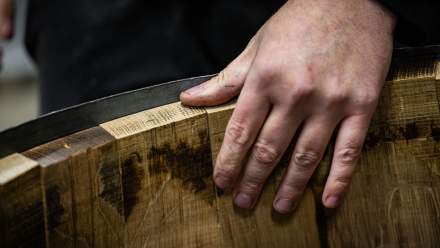
A cooper’s senses are their most valuable tools. More precise than high-sensitivity sonar, the eye and hand identify and sort the best staves. The touch of the grain, the color, the regularity of the veins; these are clues that only human expertise can interpret. Whether selecting fine-grained wood for smooth tannins or rustic wood for powerful wines, interpretation is one of the cooper’s key skills.
The surgical precision of assembling staves and tensioning the hoops is honed by listening to the wood. Every creak is a language, revealing resistance, alignment angles, and pressure. By listening, the Remond cooper understands the wood’s behavior and adjusts their movements. Toasting, a critical moment when the wood reveals its soul, relies on the sense of smell. The aromas released by the flame-kissed wood inform the cooper about the chemical transformations underway and the aromatic profile taking shape. Between “controlled toasting” and “burnt,” the cooper must delicately fine-tune the heat to create a barrel that harmonizes with the wine it will hold.
In daily contact with the material, the cooper comes to see wood as a partner, almost a confidant; one whose reactions can be anticipated with experience and humility.
Heritage and Innovation
From past to present, the cooper’s craft has evolved to meet the demands of the times, the exact expectations of winemakers, and the need for sustainable resources. While digital and mechanical tools ease the workload, they do not diminish the importance of sensory control. The cooper continues to adapt their gestures to the wood’s nuances, revealing its best qualities: cutting, toasting, assembling. Physical, precise, and demanding, the profession requires both technical and human qualities. A talented cooper is curious about the material, sees the invisible, and hears the imperceptible.
If one barrel hides another, none are truly alike, and adaptability remains a hallmark of a profession that banishes monotony through constant new challenges.
The Pride of a Living Craft
The greatest reward? Seeing a Remond barrel welcome a prestigious cuvée, hearing a winemaker describe the impact of the barrel on an award-winning wine, or passing on to a young apprentice that “silent dialogue with the material” that no manual can teach. As a symbol of French heritage, wine; and thus the barrel; embodies an identity more than ever. Being a cooper means choosing a profession of art, rigor, and passion. A bridge between past and present, both guardian of a legacy and ambassador of a forward-looking craft, the cooper perpetuates a gesture steeped in history.