
Behind the Scenes in the Workshop – 19 Control Points for an Exceptional Barrel
It All Starts with the Wood
Everything begins long before the wood even enters the workshop. “A fine barrel begins with a fine tree,” the team reminds us, and this principle guides the selection of oak trees, aged 80 to 120 years, chosen for their French origin, initial moisture content, and flawless condition. Then comes the drying process, long, slow, and essential: 24 months in the open air, a strictly controlled final moisture level, and dimensional stability checked stave by stave.
Measuring, Observing, Sensing
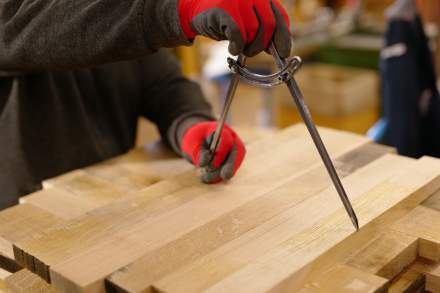
In the workshop, each stave is then examined down to the millimeter. Here, industrial precision meets artisanal sensitivity. The caliper measures, but it is the hand that judges. Thickness, width, curvature, chamfers, every detail contributes to the precision of the assembly. Once the barrel is formed, the tension of the hoops, its roundness, symmetry, and above all, the tightness of the joints are all checked.
Then comes toasting, a pivotal moment in defining the barrel’s future character. Its intensity is tailored to the customer’s request, and its uniformity is meticulously verified. Here, technology will never replace the cooper’s expertise: the nose detects a burnt smell or wood that is still too green, the touch reveals a rough spot, the eye perceives an unusual shade. The machine measures, but the human judges.
No Detail Is Overlooked
Smoothing, cleanliness, branding, weight, final tightness: the checks continue until the barrel is ready to leave the workshop. Each step is performed under the operator’s responsibility, with additional verification by the quality department. Laboratory sanitary analyses complete this system. And when a non-conformity arises, it becomes a source of learning: repair, reuse, or recycling as appropriate, followed by root cause analysis to improve processes.
This obsession with detail makes the difference: Remond boasts a return rate of less than 0.1%, reproducible aromatic precision, and renewed trust from vintage to vintage.